
Each state has its own laws addressing intergovernmental purchasing by local government agencies.
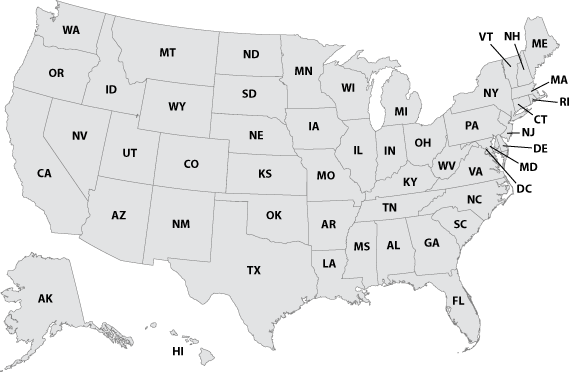
Please click a state on the map to display the Intergovernmental Purchasing Statutes by state.
The material provided on this page is for informational and educational purposes only and should not be construed as legal advice. It may not contain the most up to date changes in the law. Please consult with your legal counsel for further details on your state's own laws addressing intergovernmental purchasing.
Alabama
Article 3: Competitive Bidding on Contracts of Certain State and Local Agencies, etc.
Section 41-16-51
Contracts for which competitive bidding not required
(16) Subject to the limitations in this subdivision, purchases of goods made as a part of the purchasing cooperative sponsored by the National Association of Counties, its successor organization, or any other competitive bid nationwide cooperative purchasing program, or other national or regional governmental cooperative purchasing program. This subdivision shall not apply to goods for which a service or service contract, whether subject to competitive bidding under this article or not, is necessary to utilize the goods. Such purchases may only be made if all of the following occur:
- The goods being purchased are available as a result of a competitive bid process conducted by a governmental entity and approved by the Alabama Department of Examiners of Public Accounts for each bid.
- The goods are either not at the time available to counties on the state purchasing program or are available at a price equal to or less than that on the state purchasing program.
- The purchase is made through a participating Alabama vendor holding an Alabama business license if such a vendor exists.
- The entity purchasing goods under this subdivision has been notified by the Department of Examiners of Public Accounts that the competitive bid process utilized by the cooperative program offering the goods complies with this subdivision.
This code pertains to the following political subdivisions only:
- Municipalities
- State Colleges or Universities under the supervision and control of the State Board of Education
- State Junior Colleges
- State Trade Schools
- County Commissions
- Governing Boards of Instrumentalities of Counties and Municipalities, including Waterworks Boards, Sewer Boards, Gas Boards, and other like Utility Boards and Commissions
Alaska
Title 36 Public Contracts
Chapter 36.30 State Procurement Code
Chapter 102 Common Service Contracts by Article 9 Intergovernmental Relations
36.30.790: Definitions
In AS 36.30.700 - 36.30.790
- "cooperative purchasing" means procurement conducted by, or on behalf of, more than one public procurement unit, or by a public procurement unit with an external procurement activity;
- "external procurement activity" means a buying organization not located in this state that, if located in this state, would qualify as a public procurement unit; an agency of the United States is an external procurement activity;
- "local public procurement unit" means a municipality or other subdivision of the state or other entity that expends public funds for the procurement of supplies, services, professional services, and construction, and any nonprofit corporation operating a charitable hospital;
- "public procurement unit" means either a local public procurement unit or a state public procurement unit;
- "state public procurement unit" means the Department of Administration and any other contracting agency of the state.
36.30.700: Cooperative purchasing authorized.
Arizona
Title 11 Counties
Chapter 7 Intergovernmental Cooperation
Article 1 General Provisions
11-952. Joint exercise of powers; definitions
A. Any power or powers, privileges or authority exercised or capable of exercise by a public agency of this state may be exercised and enjoyed jointly with any other public agency of this state having the power or powers, privilege or authority, and jointly with any public agency of any other state or of the United States to the extent that laws of such other state or of the United States permit such joint exercise or enjoyment. Any agency of the state government when acting jointly with any public agency may exercise and enjoy all of the powers, privileges and authority conferred by this article upon a public agency.
B. For the purposes of this article:
- "Public agency" means any political subdivision or municipal corporation of this state and any agency of the state government or of the United States, and any political subdivision or municipal corporation of another state.
- "State" means a state of the United States and the District of Columbia.
Arkansas
Title 25 State Government
Chapter 1 General Provisions
Subchapter 8 Interlocal Cooperation
25-1-801. Purpose
It is the purpose of this subchapter to permit local governmental units to make the most efficient use of their powers by enabling them to cooperate with other localities on a basis of mutual advantage and thereby to provide services and facilities in a manner and pursuant to forms of governmental organization that will accord best with geographic, economic, population, and other factors influencing the needs and development of local communities.
25-1-803. Definitions
As used in this subchapter:
- "Interlocal agreement" means an agreement entered into pursuant to this subchapter.
- "Public agency" means a political subdivision, agency, or officer of this state or of any state of the United States, including, but not limited to, state government, county, city, school district, single and multipurpose special district, single and multipurpose public authority, metropolitan or consolidated government, an independently elected county officer, any agency of the United States Government, a federally recognized Native American tribe, and any similar entity of any other state of the United States.
- "State" means a state of the United States.
- "Person" means:
- Any natural person;
- The United States; any state; any municipality, political subdivision, or municipal corporation created by or pursuant to the laws of the United States or any state; or any board, corporation, or other entity or body declared by or pursuant to the laws of the United States or any state to be a department, agency, or instrumentality thereof;
California
Government Code
Title 1 General
Division 7 Miscellaneous
Chapter 5 Joint Exercise of Powers
6500. As used in this chapter:
- "Public agency" means the federal government or any federal department or agency, this state, another state or any state department or agency, a county, city, district, public authority, public agency, and any other political subdivision or public corporation in this state or another state.
- "State" means this state, another state, or any state department or agency.
§ 6502. Joint powers agreements
If authorized by their legislative or other governing bodies, two or more public agencies by agreement may jointly exercise any power common to the contracting parties, including the power to levy a fee, assessment, or tax, even though one or more of the contracting agencies may be located outside this state.
Colorado
Title 29 Government - Local
Article 1 Local Government Powers
Part 2 Intergovernmental Relations
29-1-203. Joint exercise of powers - agreements
|
Colorado Revised Statutes
Title 24 Government - State Article 110 Intergovernmental Relations |
|
24-110-101: Definitions.
|
|
|
24-110-201. Cooperative purchasing authorized.
|
|
Any public procurement unit may either participate in, sponsor, conduct, or administer a cooperative purchasing agreement for the procurement of any supplies, services, or construction with one or more public procurement units, external procurement activities, or procurement consortiums which include as members tax-exempt organizations as defined by section 501 (c)(3) of the federal "Internal Revenue Code of 1986", as amended, in accordance with an agreement entered into between the participants. Such cooperative purchasing may include, but is not limited to, joint or multiparty contracts between public procurement units and open-ended state public procurement unit contracts which are made available to local public procurement units. |
Connecticut
|
Connecticut Statutes
Title 14 Chapter 58 Purchases and Printing |
|
Sec. 4a-53 (Formerly Sec. 4-110c). Cooperative Purchasing Plans
|
|
Section 4a-53 of the general statutes is repealed and the following is substituted in lieu thereof (Effective from passage): |
|
Connecticut Statutes
Title 7 Municipalities Chapter 98 Municipal Powers |
|
Sec. 7-148cc: Joint performance of municipal functions.
|
|
Two or more municipalities may jointly perform any function that each municipality may perform separately under any provisions of the general statutes or of any special act, charter or home rule ordinance. Each participating municipality shall approve any agreement entered into pursuant to this section in the same manner as an ordinance is approved in such participating municipality or, if no ordinances are approved by such participating municipality, in the same manner as the budget is approved. The terms of each agreement shall establish a process for withdrawal from such agreement and shall require that the agreement be reviewed at least once every five years by the body that approved the agreement to assess the effectiveness of such agreement in enhancing the performance of the function that is the subject of the agreement. As used in this section, "municipality" means any municipality, as defined in section 7-187, or any district, as defined in section 7-324, located within the state of Connecticut. |
|
Sec. 7-187. Definitions.
|
|
Whenever used in sections 7-188 to 7-193, inclusive: |
Delaware
|
Delaware Code
Title 29 State Government Part VI Budget, Fiscal, Procurement and Contracting Regulations Chapter 69. State Procurement Subchapter VI |
|
29 Del. C. § 6987: Cooperative Procurement
|
|
An agency may participate in, sponsor, conduct or administer a cooperative agreement for the procurement of professional services with 1 or more public procurement units either within this State, with or within another state, or with a consortium of other states in accordance with an agreement entered into between the participants. Such agreement may include material and/or nonprofessional services with professional services. |
District of Columbia
|
District of Columbia Code
Division I Government of District Title 2 Government Administration Chapter 3 Procurement Unit A Procurement Practices for the District Government Subchapter XI Miscellaneous |
|
§ 2-311.02. Cooperative purchasing agreement.
|
|
(a) The Director shall be authorized and encouraged to participate in, sponsor, conduct, or administer cooperative purchasing agreements with any state, county, or municipal jurisdiction for the purpose of procuring supplies and services, which shall include construction services or architectural and engineering services related to construction repairs, upgrades, restoration, alteration, and reconstruction of existing buildings and facilities. Cooperative purchasing agreements entered into by the District government shall be in accordance with, to the extent practicable, all laws, statutes, and regulations of the District government with respect to contracting, and shall not be inconsistent with laws, statutes, and regulations of the United States government that apply specifically to the District. (b) The District government may not participate in any cooperative purchasing agreement pursuant to subsection (a) of this section that does not mandate minimum minority business participation levels equal to those required by subchapter VIII of Chapter 2 of this title. (c) Cooperative purchasing agreements may include, but not be limited to, the following: (1) Agreements for the cooperative purchasing of supplies and services; (2) Agreements for the sale, purchase, or use of property belonging to either the District or a neighboring jurisdiction; (3) Agreements for the common use of facilities equipment; (4) Agreements for automated databases; or (5) Agreements for construction services or architectural and engineering services related to the repair, upgrade, restoration, alteration and reconstruction of buildings and facilities. (d) No agency shall enter into or participate in a cooperative purchasing agreement unless that participation is authorized by the Director pursuant to the District Government Procurement Regulations. |
Florida
Title X Public Officers, Employees, and Records
Chapter 163 Intergovernmental Programs
Part I Interlocal Cooperation Act
163.01. Short title
This part may be cited as the "Interlocal Cooperation Act."
163.01. Definitions
As used in this part:
- "Public agency" means any political subdivision of this state, including, but not limited to, any county, municipality, school district, or special district, and any agency of the state government or any agency of the United States government.
- "State" means a state of the United States and the District of Columbia.
163.01. Joint exercise of powers
Any power or powers, privileges, or authority exercised or capable of exercise by a public agency of this state may be exercised and enjoyed jointly with any other public agency of this state having the power or powers, privilege, or authority, and jointly with any public agency of any other state or of the United States to the extent that laws of such other state or of the United States permit such joint exercise or enjoyment.
Georgia
Title 36 Local Government
Chapter 69 Intergovernmental Relations
Article 1 Interlocal Cooperation
36-69-1. Short title
This article shall be known and may be cited as the "Interlocal Cooperation Act."
36-69-2. Definitions
As used in this article:
- "Public agency" means any political subdivision or municipal corporation of this state and any agency of the state government or of the United States, and any political subdivision or municipal corporation of another state.
- "State" means a state of the United States and the District of Columbia.
36-69-3. Joint exercise of powers
Any power or powers, privileges, or authority exercised or capable of exercise by a public agency of this state may be exercised and enjoyed jointly with any other public agency of this state having the power or powers, privilege, or authority, and jointly with any public agency of any other state or of the United States to the extent that laws of such other state or of the United States permit such joint exercise or enjoyment.
Hawaii
Title 1 General Provisions
Chapter 1 Definitions
Section 1-1
Definitions
As used in this chapter:
- "Public agency" means any political subdivision or municipal corporation of this state and any agency of the state government or of the United States, and any political subdivision or municipal corporation of another state.
- "State" means a state of the United States and the District of Columbia.
Joint exercise of powers
Any power or powers, privileges, or authority exercised or capable of exercise by a public agency of this state may be exercised and enjoyed jointly with any other public agency of this state having the power or powers, privilege, or authority, and jointly with any public agency of any other state or of the United States to the extent that laws of such other state or of the United States permit such joint exercise or enjoyment.
Idaho
Title 67 State Government and State Affairs
Chapter 23 Miscellaneous Provisions
Section 67-2327
Definitions
As used in this chapter:
- "Public agency" means any city or political subdivision of this state, including, but not limited to counties; school districts; highway districts; and port authorities; instrumentalities of counties, cities or any political subdivision created under the laws of the state of Idaho; any agency of the state government; and any city or political subdivision of another state.
- "State" means a state of the United States and the District of Columbia.
67-2328. Joint Exercise of Powers
(a) Any power, privilege or authority, authorized by the Idaho Constitution, statute or charter, held by the state of Idaho or a public agency of said state, may be exercised and enjoyed jointly with the state of Idaho or any other public agency of this state having the same powers, privilege or authority; but never beyond the limitation of such powers, privileges or authority; and the state or public agency of the state, may exercise such powers, privileges and authority jointly with the United States, any other state, or public agency of any of them, to the extent that the laws of the United States or sister state, grant similar powers, privileges or authority, to the United States and its public agencies, or to the sister state and its public agencies.
Illinois
Title 5 Local Government
Chapter 5 Intergovernmental Cooperation
Article 1 Intergovernmental Cooperation Act
5 ILCS 220/1. Short title
This Act may be cited as the Intergovernmental Cooperation Act.
5 ILCS 220/2. Definitions
As used in this Act:
- "Public agency" means any political subdivision or municipal corporation of this State and any agency of the State government or of the United States, and any political subdivision or municipal corporation of another state.
- "State" means a state of the United States and the District of Columbia.
5 ILCS 220/3. Joint exercise of powers
Any power or powers, privileges or authority exercised or capable of exercise by a public agency of this State may be exercised and enjoyed jointly with any other public agency of this State having the power or powers, privilege or authority, and jointly with any public agency of any other state or of the United States to the extent that laws of such other state or of the United States permit such joint exercise or enjoyment.
Indiana
Title 36 Local Government
Article 1 General Provisions
Chapter 7 Intergovernmental Cooperation
36-1-7-1. Short title
This chapter may be cited as the Intergovernmental Cooperation Act.
36-1-7-2. Definitions
As used in this chapter:
- "Public agency" means any political subdivision or municipal corporation of this state and any agency of the state government or of the United States, and any political subdivision or municipal corporation of another state.
- "State" means a state of the United States and the District of Columbia.
36-1-7-3. Joint exercise of powers
Any power or powers, privileges or authority exercised or capable of exercise by a public agency of this state may be exercised and enjoyed jointly with any other public agency of this state having the power or powers, privilege or authority, and jointly with any public agency of any other state or of the United States to the extent that laws of such other state or of the United States permit such joint exercise or enjoyment.
Iowa
|
Title I State Sovereignty and Management
Subtitle 10. Joint Governmental Activity Chapter 28E Joint Exercise of Governmental Powers |
|
28E.1: Purpose
|
|
The purpose of this chapter is to permit state and local governments in Iowa to make efficient use of their powers by enabling them to provide joint services and facilities with other agencies and to cooperate in other ways of mutual advantage. This chapter shall be liberally construed to that end. |
|
28E.2: Definitions
|
|
For the purposes of this chapter, the term "public agency" shall mean any political subdivision of this state; any agency of the state government or of the United States; and any political subdivision of another state. The term "state" shall mean a state of the United States and the District of Columbia. The term "private agency" shall mean an individual and any form of business organization authorized under the laws of this or any other state |
|
28E.3: Joint exercise of powers
|
|
Any power or powers, privileges or authority exercised or capable of exercise by a public agency of this state may be exercised and enjoyed jointly with any other public agency of this state having such power or powers, privilege or authority, and jointly with any public agency of any other state or of the United States to the extent that laws of such other state or of the United States permit such joint exercise or enjoyment. Any agency of the state government when acting jointly with any public agency may exercise and enjoy all of the powers, privileges and authority conferred by this chapter upon a public agency. |
Kansas
|
Chapter 12 Cities and Municipalities
Article 29 Interlocal Cooperation |
|
§ 11-102-1. 12-2901: Purpose of Act.
|
|
It is the purpose of this act to permit local governmental units to make the most efficient use of their powers by enabling them to cooperate with other localities, persons, associations and corporations on a basis of mutual advantage and thereby to provide services and facilities in a manner and pursuant to forms of governmental organization that will accord best with geographic, economic, population and other factors influencing the needs and development of local communities. |
|
12-2903: Definitions.
|
|
(a) The term "public agency" shall mean any county, township, city, town, village, school district, library district, road district, drainage or levee district, sewer district, water district, fire district or other municipal corporation, quasi-municipal corporation or political subdivision of this state or of any other state and any agency or instrumentality of this state or any other state or of the United States;
|
|
12-2904: Interlocal agreements by public agencies; specifications; approval of attorney general, exceptions.
|
|
(a) Any power or powers, privileges or authority exercised or capable of exercise by a public agency of this state including but not limited to those functions relating to economic development, public improvements, public utilities, police protection, libraries, data processing services, educational services, building and related inspection services, flood control and storm water drainage, weather modification, sewage disposal, refuse disposal, park and recreational programs and facilities, ambulance service, fire protection, the Kansas tort claims act or claims for civil rights violations, may be exercised and enjoyed jointly with any other public agency of this state or with any private agency, and jointly with any public agency of any other state or of the United States to the extent that the laws of such other state or of the United States permit such joint exercise or enjoyment. Any agency of the state government when acting jointly with any public or private agency may exercise and enjoy all of the powers, privileges and authority conferred by this act upon a public agency. |
Kentucky
|
Title VI Financial Administration
Chapter 45A Kentucky Model Procurement Code |
|
45A.295: Definitions for terms used in KRS 45A.295 to 45A.320.
|
|
(1) "State public purchasing unit" shall mean the Finance and Administration Cabinet and any other purchasing agency of this Commonwealth. (2) "Local public purchasing unit" shall mean any county, city, governmental entity and other subdivision of the Commonwealth or public agency thereof, public authority, public educational, health, or other institution, any other entity which expends public funds for the acquisition or leasing of supplies, services, and construction, and any nonprofit corporation operating a charitable hospital. (3) "Public purchasing unit" shall mean either a local public purchasing unit or a state public purchasing unit. (4) "Foreign purchasing activity" shall mean any buying organization not located in this Commonwealth which, if located in this Commonwealth, would qualify as a public purchasing unit. An agency of the United States government is a foreign purchasing activity. (5) "Cooperative purchasing" shall mean purchasing conducted by, or on behalf of, more than one (1) public purchasing unit, or by a public purchasing unit with a foreign purchasing activity. |
|
45A.300: Cooperative purchasing.
|
|
(2) Nothing in this code shall limit any public purchasing unit from selling to, acquiring from, or using any property belonging to another public purchasing unit or foreign purchasing activity independent of the requirements of KRS 45A.070 to 45A.180. (3) Nothing in this code shall limit or restrict any public purchasing unit from entering into an agreement, independent of the requirements of KRS 45A.045(5) and KRS 45A.070 to 45A.165, with any other public purchasing unit or foreign purchasing activity for the cooperative use of supplies or services. (4) Any public purchasing unit may enter into an agreement for the joint or common use of warehousing facilities or the lease or common use of capital equipment or facilities with any other public purchasing unit or a foreign purchasing activity subject to the terms as may be agreed upon between the parties. (5) Nothing in this code shall limit or restrict the ability of local school districts to acquire supplies outside of the public purchasing agreements when the supplies and equipment meeting the same specifications as the contract items are available at a lower price elsewhere and the purchase does not exceed two thousand five hundred dollars ($2,500). (6) Nothing in this code shall limit any public purchasing unit from receiving notice of or accepting a price reduction on supplies or equipment when the supplies or equipment are being offered by the vendor with whom a price agreement has been made; the supplies or equipment are being offered in accordance with all terms and conditions that are specified in the price agreement, except those relating to price; and the price reduction is offered to all of the participants in the price agreement. Public purchasing units may accept special price reductions under this subsection even if the reduced price requires the purchase of a specified quantity of units different from the quantity stated in the original price agreement. Price reductions under this subsection shall not be considered to permanently alter the price of the supplies or equipment under the price agreement with the Commonwealth, except where the price reductions are to be made permanent under the express terms of the price agreement and where the purchasing agency which solicited the price agreement determines that the enforcement of those terms serves the best interest of the Commonwealth. |
Louisiana
|
Title 39 Public Finance
Subtitle III. General Laws on State Debt Chapter 17. Louisiana Procurement Code Part VII Intergovernmental Relations |
|
39:1701: Definitions of terms used in this Part
|
|
(1) "Cooperative purchasing" means procurement conducted by or on behalf of more than one public procurement unit or by a public procurement unit with an external procurement activity or by a private procurement unit. (2) "External procurement activity" means any buying organization not located in this state which, if located in this state, would qualify as a public procurement unit. An agency of the United States government is an external procurement activity. (3) "Local public procurement unit" means any parish, city, town, governmental body, and any other subdivision of the state or public agency thereof, public authority, public educational, health, or other institution, and to the extent provided by law, any other entity which expends public funds for the acquisition or leasing of supplies, services, major repairs, and construction, and any nonprofit corporation operating a charitable hospital. (4) "Private procurement unit" means any independent institution of higher education in this state. (5) "Public procurement unit" means either a local public procurement unit or a state public procurement unit. (6) "State public procurement unit" means the central purchasing agency and any other purchasing agency of this state. |
|
39:1702: Cooperative purchasing authorized; participation in Federal General Services Administration vendor list
|
|
A. (1) Any public procurement unit may either participate in, sponsor, conduct, or administer a cooperative purchasing agreement for the acquisition of any supplies, services, major repairs, or construction with one or more public procurement units or external procurement activities or one or more private procurement units in accordance with an agreement entered into between the participants. Such cooperative purchasing may include but is not limited to joint or multi-party contracts between public procurement units and open-minded state public procurement unit contracts which are made available to local public procurement units. |
|
39:1704. Cooperative use of supplies or services
|
|
Any public procurement unit may enter into an agreement, independent of the requirements of Part III of this Chapter or Title 38, with any other public procurement unit or external procurement activity for the cooperative use of supplies or services, under the terms agreed upon between the parties. |
|
Louisiana Constitution |
|
Article 7.14 (C)
|
|
Cooperative Endeavors: |
|
Revised Statutes
|
|
TITLE 38:3383: Cooperative Endeavors
|
|
Any state agency, any parish or municipal governing authority, any regional governing authority, and the governing authority of any airport or deep draft or shallow draft port may engage in one or more cooperative endeavors under the provisions of Article VII, Section 14(C) of the Constitution of Louisiana, among themselves for the purposes of this Chapter. |
Maine
|
Maine Revised Statutes
Title 30-A Municipalities and Counties Part 2 Municipalities Subpart 2: Organization and Interlocal Corporation |
|
30-A M.R.S.A. § 2201: Purpose
|
|
It is the purpose of this chapter to permit public agencies, as defined in section 2202, including, but not limited to, municipalities, counties, school administrative units and state agencies, to make the most efficient use of their powers by enabling them to cooperate on a basis of mutual advantage and thereby to provide services and facilities in a manner and pursuant to forms of governmental organization that will accord best with geographic, economic, population and other factors influencing the needs and development of communities. |
|
30-A M.R.S.A. § 2202: Definitions
|
|
As used in this chapter, unless the context otherwise indicates, the following terms have the following meanings. 1. Public agency. "Public agency" means: A. Any political subdivision of the State, as defined in section 2252, or any adjoining state; or B. Repealed. C. Any agency of State Government or the Federal Government. |
|
30-A M.R.S.A. § 2252: "Political subdivision" defined
|
|
"Political subdivision" means any municipality, plantation, county, quasi-municipal corporation and special purpose district, including, but not limited to, any water district, sanitary district, hospital district, municipal transmission and distribution utility and school administrative unit. "School administrative unit" has the same meaning as found in Title 20-A, section 1, subsection 26. |
|
30-A M.R.S.A. § 2203: Joint exercise of powers
|
|
Any power or powers, privileges or authority exercised or capable of exercise by a public agency of the State may be exercised and enjoyed jointly with any other public agency of this State, or of the Federal Government to the extent that federal laws permit the joint exercise. When acting jointly with any public agency, any agency of State Government may exercise all of the powers, privileges and authority conferred by this chapter upon a public agency.
|
Maryland
|
State Finance and Procurement
Division 2 Procurement Title 13 Source Selection for Procurement Contracts Subtitle 1: Methods for Selecting Procurement Sources |
|
§ 13-110 STATE FIN. & PROC: Procurement by intergovernmental cooperative purchasing agreement.
|
|
1) "Governmental entity" means: i. the federal government or an agency or other instrumentality of the federal government; ii. another state or an agency or other instrumentality of another state; iii. a bistate or multistate agency; iv. a county, municipal corporation, or other political subdivision of the State or of another state, or an agency orother instrumentality of the political subdivision; v. a bicounty or multicounty agency; vi. a primary procurement unit; or vii. an affiliation, alliance, consortium, or group composed solely of governmental entities that is established for purposes of promoting intergovernmental cooperative purchasing. 2) "Intergovernmental cooperative purchasing agreement" means a contract: (i) 1. entered into by at least one governmental entity and a person selected in a manner that is consistent with the purposes set forth under § 11-201 of this article; 2. that is available for use by the governmental entity entering the contract and at least one additional governmental entity which may, but need not be, an original party to the contract; and 3. that is intended to promote efficiency and savings that can result from intergovernmental cooperative purchasing; or (ii) between a primary procurement unit and a person who, at the time the intergovernmental cooperative purchasing agreement is awarded, has a contract with the federal government or an agency or other instrumentality of the federal government, and who agrees to provide the unit with identical prices, terms, and conditions as stipulated in the federal contract. (b) Participation of primary procurement unit. 1) Subject to § 12-107 of this article and paragraph (3) of this subsection, whenever a primary procurement unit procurement officer determines that it is in the best interest of the State to sponsor or participate in an intergovernmental cooperative purchasing agreement, with the approval of the unit head and subject to any other approval required by law, the primary procurement unit may become a party to or participate under the agreement. 2) A determination under this subsection shall be in writing and include a statement that the intergovernmental cooperative purchasing agreement: (i) will provide cost benefits to the State, promote administrative efficiencies, or promote intergovernmental cooperation; and (ii) is not intended to evade the purposes of this Division II. 3) A primary procurement unit may not participate under a federal contract if the State’s participation is valued at less than $250,000. (c) Sponsorship of intergovernmental cooperative purchasing agreement; award of contract. 1) If a primary procurement unit sponsors an intergovernmental cooperative purchasing agreement: i. the contract shall be awarded in the same manner as the contract would be awarded under this Division II if the unit was the sole participant under the contract; and ii. all procedures under this Division II, including procedures governing contract claims and protests, shall apply. 2) A political subdivision of the State may participate under any intergovernmental cooperative purchasing agreement sponsored by a primary procurement unit in a manner consistent with the terms of the agreement. |
Massachusetts
Title VII Cities, Towns and Districts
Chapter 40B Intergovernmental Cooperation
§1. Short title
This chapter shall be known and may be cited as the "Intergovernmental Cooperation Act."
§2. Definitions
As used in this chapter:
- "Public agency" means any political subdivision or municipal corporation of this state and any agency of the state government or of the United States, and any political subdivision or municipal corporation of another state.
- "State" means a state of the United States and the District of Columbia.
§3. Joint exercise of powers
Any power or powers, privileges or authority exercised or capable of exercise by a public agency of this state may be exercised and enjoyed jointly with any other public agency of this state having the power or powers, privilege or authority, and jointly with any public agency of any other state or of the United States to the extent that laws of such other state or of the United States permit such joint exercise or enjoyment.
Michigan
Title 124 Municipalities
Chapter 1 General Provisions
Part 1 Intergovernmental Cooperation
124.1. Short title
This part shall be known and may be cited as the "Intergovernmental Cooperation Act."
124.2. Definitions
As used in this part:
- "Public agency" means any political subdivision or municipal corporation of this state and any agency of the state government or of the United States, and any political subdivision or municipal corporation of another state.
- "State" means a state of the United States and the District of Columbia.
124.3. Joint exercise of powers
Any power or powers, privileges or authority exercised or capable of exercise by a public agency of this state may be exercised and enjoyed jointly with any other public agency of this state having the power or powers, privilege or authority, and jointly with any public agency of any other state or of the United States to the extent that laws of such other state or of the United States permit such joint exercise or enjoyment.
Minnesota
Title 471 Local Government
Chapter 1 General Provisions
Part 1 Intergovernmental Cooperation
471.59. Short title
This part shall be known and may be cited as the "Intergovernmental Cooperation Act."
471.60. Definitions
As used in this part:
- "Public agency" means any political subdivision or municipal corporation of this state and any agency of the state government or of the United States, and any political subdivision or municipal corporation of another state.
- "State" means a state of the United States and the District of Columbia.
471.61. Joint exercise of powers
Any power or powers, privileges or authority exercised or capable of exercise by a public agency of this state may be exercised and enjoyed jointly with any other public agency of this state having the power or powers, privilege or authority, and jointly with any public agency of any other state or of the United States to the extent that laws of such other state or of the United States permit such joint exercise or enjoyment.
Mississippi
|
Mississippi Code of 1972
Title 31 Public Business, Bonds and Obligations Chapter 7 Public Purchases |
|
§ 31-7-1: Definitions.
|
|
(b) "Governing authority" shall mean boards of supervisors, governing boards of all school districts, all boards of directors of public water supply districts, boards of directors of master public water supply districts, municipal public utility commissions, governing authorities of all municipalities, port authorities, commissioners and boards of trustees of any public hospitals, boards of trustees of public library systems, district attorneys, school attendance officers and any political subdivision of the state supported wholly or in part by public funds of the state or political subdivisions thereof, including commissions, boards and agencies created or operated under the authority of any county or municipality of this state. The term "governing authority" shall not include economic development authorities supported in part by private funds, or commissions appointed to hold title to and oversee the development and management of lands and buildings which are donated by private individuals to the public for the use and benefit of the community and which are supported in part by private funds. |
|
§ 31-7-13: Bid requirements and exceptions; public auctions.
|
|
(m) Exceptions from bidding requirements - Excepted from bid requirements are: |
Missouri
|
Title VI County, Township & Political Subdivision Government
Chapter 70 Powers of Political Subdivisions to Cooperate or Contract with Governmental Units |
|
70.210: Definitions.
|
|
(1) "Governing body", the board, body or persons in which the powers of a municipality or political subdivision are vested; (2) "Municipality", municipal corporations, political corporations, and other public corporations and agencies authorized to exercise governmental functions; (3) "Political subdivision", counties, townships, cities, towns, villages, school, county library, city library, city-county library, road, drainage, sewer, levee and fire districts, soil and water conservation districts, watershed subdistricts, county hospitals, and any board of control of an art museum, and any other public subdivision or public corporation having the power to tax. |
|
70.220: Political subdivisions may cooperate with each other, with other states, the United States or private persons
|
|
|
Montana
|
Title 18 Public Contracts
Chapter 4 Montana Procurement Act Part 4 Cooperative Purchasing |
|
18-4-401. Definitions
|
|
As used in this part, the following definitions apply:
|
|
18-4-124. Local government adoption of procurement provisions
|
|
A political subdivision or school district may adopt any or all parts of this chapter and the accompanying rules promulgated by the department. |
|
18-4-402. Cooperative purchasing authorized
|
|
The department may participate in, sponsor, conduct, or administer a cooperative purchasing agreement for the procurement of any supplies or services with one or more public procurement units in accordance with an agreement entered into between the participants independent of the requirements of part 3. Cooperative purchasing may include purchasing through federal supply schedules of the United States general services administration, joint or multiparty contracts between public procurement units and open-ended state public procurement unit contracts that are made available to local public procurement units. |
Nebraska
|
Chapter 13 Cities, Counties, and Political Subdivisions
|
|
13-2503. Terms, defined.
|
|
For purposes of the Joint Public Agency Act: |
|
13-2505. Joint exercise of powers.
|
|
Notwithstanding any restrictions contained in a city charter, any power, privilege, or authority exercised or capable of exercise by a public agency of this state may be exercised and enjoyed jointly with any other public agency of this state and jointly with any public agency of any other state or of the United States to the extent that laws of such other state or of the United States permit such joint exercise or enjoyment. Any agency of state government when acting jointly with any public agency may exercise and enjoy all of the powers, privileges, and authority conferred by the Joint Public Agency Act upon a public agency. |
Nevada
|
Title 27 – Public Property and Purchasing
Chapter 232 Purchasing: Local Governments General Provisions |
|
NRS 332.015 "Local government" defined
|
|
For the purpose of this chapter, unless the context otherwise requires,"local government" means:
|
|
NRS 332.195 Joinder or mutual use of contracts by local governments
|
|
|
NRS 332.115 Contracts not adapted to award by competitive bidding; purchase of equipment by local law enforcement agency or local fire department; purchase of goods commonly used by hospital
|
(m) Supplies, materials or equipment that are available pursuant to an agreement with a vendor that has entered into an agreement with the General Services Administration or another governmental agency located within or outside this state; |
New Hampshire
|
Title III Towns, Cities, Village Districts and Unincorporated Places
Chapter 53-A Agreements Between Government Units |
|
53-A:1 Purpose.
|
|
It is the purpose of this chapter to permit municipalities and counties to make the most efficient use of their powers by enabling them to cooperate with other municipalities and counties on a basis of mutual advantage and thereby to provide services and facilities in a manner and pursuant to forms of governmental organization that will accord best with geographic, economic, population and other factors influencing the needs and development of local communities. |
|
53-A:2 Public Agency Defined
|
|
For the purposes of this chapter, the term "public agency" shall mean any political subdivision of this state or of any adjoining state and any quasi-municipal corporation, including but not limited to school districts, village districts, regional water districts, and special districts. |
|
53-A:3 Joint Exercise of Powers.
|
|
Any power or powers, privileges or authority exercised or capable of exercise by a public agency of this state may be exercised jointly with any other public agency of this state. Such authority shall include, but not be limited to, the power to enter into agreements to share tax revenues resulting from local economic development efforts and with respect to cities and towns, the power to form the entities and conduct the activities provided for in RSA 162-G. |
New Jersey
|
|
|
b. (1) The director may elect to purchase goods or services through a contract awarded pursuant to a cooperative purchasing agreement whenever the director determines this to be the most cost-effective method of procurement. Prior to entering into any contract to be awarded or already awarded through a cooperative purchasing agreement, the director shall review and approve the specifications and proposed terms and conditions of the contract. (2) The director may also elect to purchase goods or services through a contract awarded pursuant to a nationally-recognized and accepted cooperative purchasing agreement that has been developed utilizing a competitive bidding process, in which other states participate, whenever the director determines this to be the most cost-effective method of procurement. Prior to entering into any contract to be awarded through a nationally-recognized and accepted cooperative purchasing agreement that has been developed utilizing a competitive bidding process, the director shall review and approve the specifications and proposed terms and conditions of the contract. (3) Notwithstanding any other law to the contrary, any contracting unit authorized to purchase goods, or to contract for services, may make purchases and contract for services through the use of a nationally-recognized and accepted cooperative purchasing agreement that has been developed utilizing a competitive bidding process by another contracting unit 1 within the State of New Jersey, or within any other state, when available. Prior to making purchases or contracting for services, the contracting unit shall determine that the use of the cooperative purchasing agreement shall result in cost savings after all factors, including charges for service, material, and delivery, have been considered. For purposes of this paragraph, “contracting unit” means any county, municipality, special district, school district, fire district or any board, commission, committee, authority or agency, which is not a State board, commission, committee, authority or agency, and which has administrative jurisdiction over any district, included or operating in whole or in part, within the territorial boundaries of any county or municipality which exercises functions which are appropriate for the exercise by one or more units of local government, and which has statutory power to make purchases and enter into contracts awarded by a contracting agent for the provision or performance of goods or services. |
New Mexico
|
Chapter 11 Intergovernmental Agreements and Authorities
Article 1 Joint Powers Authority |
|
11-1-2. Definitions.
|
|
As used in the Joint Powers Agreements Act : |
|
11-1-3. Authority to enter into agreements; approval of the secretary of finance and administration required
|
|
If authorized by their legislative or other governing bodies, two or more public agencies by agreement may jointly exercise any power common to the contracting parties, even though one or more of the contracting parties may be located outside this state; provided, however, nothing contained in this Joint Powers Agreements Act shall authorize any state officer, board, commission, department or any other state agency, institution or authority, or any county, municipality, public corporation or public district to make any agreement without the approval of the secretary of finance and administration as to the terms and conditions thereof. Joint powers agreements approved by the secretary of finance and administration shall be reported to the state board of finance at its next regularly scheduled public meeting. A list of the approved agreements shall be filed with the office of the state board of finance and made a part of the minutes. |
|
13-1-135. Cooperative procurement authorized
|
|
A. Any state agency or local public body may either participate in, sponsor or administer a cooperative procurement agreement for the procurement of any services, construction or items of tangible personal property with any other state agency, local public body or external procurement unit in accordance with an agreement entered into and approved by the governing authority of each of the state agencies, local public bodies or external procurement units involved. The cooperative procurement agreement shall clearly specify the purpose of the agreement and the method by which the purpose will be accomplished. Any power exercised under a cooperative procurement agreement entered into pursuant to this subsection shall be limited to
the central purchasing authority common to the contracting parties, even though one or more of the contracting parties may be located outside this state. An approved and signed copy of all cooperative procurement agreements entered into pursuant to this subsection shall be filed with the state purchasing agent. A cooperative procurement agreement entered into pursuant to this subsection is limited to the procurement of items of tangible personal property, services or construction. |
New York
|
General Municipal Law
Article 5A (Public Contracts) Section 103 |
|
16. Notwithstanding the provisions of subdivisions one, two and three of this section, and section one hundred four of this article, any officer, board or agency of a county, political subdivision or of any district therein authorized to make purchases of apparatus, materials, equipment or supplies, or to contract for services related to the installation, maintenance or repair of apparatus, materials, equipment, and supplies, may make such purchases, or may contract for such services related to the installation, maintenance or repair of apparatus, materials, equipment, and supplies, as may be required by such county, political subdivision or district therein through the use of a contract let by the United States of America or
any agency thereof, any state or any other county or political subdivision or district therein if such contract was let in a manner that constitutes competitive bidding consistent with state law and made available for use by other governmental entities. |
North Carolina
|
Chapter 160A. Cities and Towns
ARTICLE 20 Interlocal Cooperation Part 1 Joint Exercise of Powers |
|
160A-460. Definitions
|
|
[**Update notice: This section has been amended by S.L. 2001-78 SESSION 2001 - HOUSE BILL 880.] |
|
160A-461. Interlocal cooperation authorized
|
|
Any unit of local government in this State and any one or more other units of local government in this State or any other state (to the extent permitted by the laws of the other state) may enter into contracts or agreements with each other in order to execute any undertaking. The contracts and agreements shall be of reasonable duration, as determined by the participating units, and shall be ratified by resolution of the governing board of each unit spread upon its minutes. |
|
North Carolina Schools
|
|
143-129. Procedure for letting of public contracts
|
|
(e) Exceptions. — The requirements of this Article do not apply to: |
North Dakota
|
Title 54 State Government
Chapter 54-40 Joint Exercise of Governmental Powers |
|
54-40.3-01. Joint powers agreements - General authority
|
|
Any county, city, township, city park district, school district, or other political subdivision of this state, upon approval of its respective governing body, may enter into an agreement with any other political subdivision of this state for the cooperative or joint administration of any power or function that is authorized by law or assigned to one or more of them. Any political subdivision of this state may enter into a joint powers agreement with a political subdivision of another state or political subdivision of a Canadian province if the power or function to be jointly administered is a power or function authorized by the laws of this state for a political subdivision of this state and is authorized by the laws of the other state or province. |
Ohio
|
State of Ohio Statutes
Ohio Revised Rule General Provisions Chapter 9: Miscellaneous |
|
§ 9.48 Joint Purchasing Programs
|
|
(A) As used in this section, “political subdivision” has the same meaning as in section 2744.01 of the Revised Code and includes a county hospital as defined in section 339.01 of the Revised Code.
(B) A political subdivision may do any of the following: (1) Permit one or more other political subdivisions to participate in contracts into which it has entered for the acquisition of equipment, materials, supplies, or services, and may charge such participating political subdivisions a reasonable fee to cover any additional costs incurred as a result of their participation; (2) Participate in a joint purchasing program operated by or through a national or state association of political subdivisions in which the purchasing political subdivision is eligible for membership. (3) Participate in contract offerings from the federal government that are available to a political subdivision including, but not limited to, contract offerings from the general services administration. (C) Acquisition by a political subdivision of equipment, material, supplies, or services, through participation in a contract of another political subdivision or participation in an association program under division (B)(1) or (2) of this section, is exempt from any competitive selection requirements otherwise required by law, if the contract in which it is participating was awarded pursuant to a publicly solicited request for a proposal or a competitive selection procedure of another political subdivision within this state or in another state. Acquisition by a political subdivision of equipment, materials, supplies, or services pursuant to division (B)(3) of this section is exempt from any competitive selection requirements otherwise required by law. No political subdivision shall acquire equipment, materials, supplies, or services by participating in a contract under this section if it has received bids for such acquisition, unless its participation enables it to make the acquisition upon the same terms, conditions, and specifications at a lower price. (D) A political subdivision that is eligible to participate in a joint purchasing program operated by or through a national or state association of political subdivisions in which the purchasing political subdivision is eligible for membership may purchase supplies or services from another party, including another political subdivision, instead of through participation in contracts authorized by division (B)(2) of this section if the political subdivision can purchase those supplies or services from the other party upon equivalent terms, conditions, and specifications but at a lower price than it can through those contracts. Purchases that a political subdivision makes under this division are exempt from any competitive selection procedures otherwise required by law. A political subdivision that makes any purchase under this division shall maintain sufficient information regarding the purchase to verify that it satisfied the conditions for making a purchase under this division. Nothing in this division restricts any action taken by a political subdivision as authorized by division (B)(1) of this section. (E) The authorization granted to a municipal corporation under this section shall be in addition to, and not in derogation of, the powers and authority granted by state law, the Ohio Constitution, and the provisions of a municipal charter, ordinance, or resolution. |
Oklahoma
|
Title 74 State Government
Chapter 31 Interlocal Cooperation Act |
|
§ 74-1001. Purpose
|
|
It is the purpose of Section 1001[74-1001] et seq. of this title to permit local governmental units to make the most efficient use of their powers by enabling them to cooperate with other localities on a basis of mutual advantage and thereby to provide services and facilities in a manner and pursuant to forms of governmental organization that will accord best with geographic, economic, population and other factors influencing the needs and development of local communities. The cooperating governmental units can, if they deem it necessary, create an entity to carry out the cooperative functions. |
|
§ 74-1003. Definitions.
|
|
A. For the purposes of Section et seq. of this title, the term "public agency" shall mean:
|
|
§ 74-1004. Agreements Authorized
|
|
A. Any power or powers, privileges or authority exercised or capable of exercise by a public agency of this state may be exercised and enjoyed jointly with any other public agency of this state, and jointly with any public agency of any other state or of the United States to the extent that laws of such other state or of the United States permit such joint exercise or enjoyment. Any agency of the state government when acting jointly with any public agency may exercise and enjoy all of the powers, privileges and authority conferred by this act upon a public agency. |
Oregon
|
Chapter 279A Public Contracting
General Provisions |
|
279A.205 Cooperative procurements authorized
|
|
|
|
279A.220 Interstate cooperative procurements
|
|
(a) The administering contracting agency’s solicitation and award process for the original contract is an open and impartial competitive process and uses source selection methods substantially equivalent to those specified in ORS 279B.055 or 279B.060; (b) The administering contracting agency’s solicitation and the original contract allows other governmental bodies to establish contracts or price agreements under the terms, conditions and prices of the original contract; and (c) The administering contracting agency permits the contractor to extend the use of the terms, conditions and prices of the original contract to the purchasing contracting agency. (2) In addition to the requirements in subsection (1) of this section: (a) The purchasing contracting agency, or the cooperative procurement group of which the purchasing contracting agency is a member, must be listed in the solicitation of the administering contracting agency as a party that may establish contracts or price agreements under the terms, conditions and prices of the original contract, and the solicitation must be advertised in Oregon; or (b)(A) The purchasing contracting agency, or the cooperative procurement group of which the purchasing contracting agency is a member, shall advertise a notice of intent to establish a contract or price agreement through an interstate cooperative procurement. (B) The notice of intent must include: (i) A description of the procurement; (ii) An estimated amount of the procurement; (iii) The name of the administering contracting agency; and (iv) A time, place and date by which comments must be submitted to the purchasing contracting agency regarding the intent to establish a contract or price agreement through an interstate cooperative procurement. (C) Public notice of the intent to establish a contract or price agreement through an interstate cooperative procurement must be given in the same manner as provided in ORS 279B.055 (4)(b) and (c). (D) Unless otherwise specified in rules adopted under ORS 279A.070, the purchasing contracting agency shall give public notice at least seven days before the deadline for submission of comments regarding the intent to establish a contract or price agreement through an interstate cooperative procurement. (3) If a purchasing contracting agency is required to provide notice of intent to establish a contract or price agreement through an interstate cooperative procurement under subsection (2) of this section: (a) The purchasing contracting agency shall provide vendors who would otherwise be prospective bidders or proposers on the contract or price agreement, if the procurement were competitively procured under ORS chapter 279B, an opportunity to comment on the intent to establish a contract or price agreement through an interstate cooperative procurement. (b) Vendors must submit comments within seven days after the notice of intent is published. (c) And if the purchasing contracting agency receives comments on the intent to establish a contract or price agreement through an interstate cooperative procurement, before the purchasing contracting agency may establish a contract or price agreement through the interstate cooperative procurement, the purchasing contracting agency shall make a written determination that establishing a contract or price agreement through an interstate cooperative procurement is in the best interest of the purchasing contracting agency. The purchasing contracting agency shall provide a copy of the written determination to any vendor that submitted comments. (4) For purposes of this section, an administering contracting agency may be any governmental body, domestic or foreign, authorized under its laws, rules or regulations to enter into contracts for the procurement of goods and services for use by a governmental body. |
|
279A.200 Definitions for ORS 279A.200 to 279A.225
|
|
(a) “Administering contracting agency” means a contracting agency that solicits and establishes the original contract for procurement of goods, services or public improvements in a cooperative procurement. (b) “Cooperative procurement” means a procurement conducted by or on behalf of one or more contracting agencies. “Cooperative procurement” includes but is not limited to multiparty contracts and price agreements. (c) “Cooperative procurement group” means a group of contracting agencies joined through an intergovernmental agreement for the purposes of facilitating cooperative procurements. (d) “Interstate cooperative procurement” means a permissive cooperative procurement in which the administering contracting agency is a governmental body, domestic or foreign, that is authorized under the governmental body’s laws, rules or regulations to enter into public contracts and in which one or more of the participating agencies are located outside this state. (e) “Joint cooperative procurement” means a cooperative procurement in which the participating contracting agencies or the cooperative procurement group and the agencies’ or group’s contract requirements or estimated contract requirements for price agreements are identified. (f) “Original contract” means the initial contract or price agreement solicited and awarded during a cooperative procurement by an administering contracting agency. (g) “Permissive cooperative procurement” means a cooperative procurement in which the purchasing contracting agencies are not identified. (h) “Purchasing contracting agency” means a contracting agency that procures goods, services or public improvements from a contractor based on the original contract established by an administering contracting agency. (2) As used in ORS 279A.210 (1)(a), 279A.215 (1)(a) and 279A.220 (1)(a), an administering contracting agency’s solicitation and award process uses source selection methods “substantially equivalent” to those identified in ORS 279B.055, 279B.060 or 279B.085 if the solicitation and award process: (a) Calls for award of a contract on the basis of a lowest responsible bidder or a lowest and best bidder determination in the case of competitive bids, or on the basis of a determination of the proposer whose proposal is most advantageous based on evaluation factors set forth in the request for proposals in the case of competitive proposals; (b) Does not permit the application of any geographic preference that is more favorable to bidders or proposers who reside in the jurisdiction or locality favored by the preference than the preferences provided in ORS 279A.120 (2); and (c) Uses reasonably clear and precise specifications that promote suitability for the purposes intended and that reasonably encourage competition. |
Pennsylvania
|
Title 62 Procurement (Pa.C.S.A.)
Part I Commonwealth Procurement Code Chapter 19 Intergovernmental Relations |
|
62 Pa.C.S.A. § 1901. Definitions
|
|
The following words and phrases when used in this chapter shall have the meanings given to them in this section unless the context clearly indicates otherwise: |
|
62 Pa.C.S.A. § 1902. Cooperative purchasing authorized
|
|
A public procurement unit may either participate in, sponsor, conduct or administer a cooperative purchasing agreement for the procurement of any supplies, services or construction with one or more public procurement units or external procurement activities in accordance with an agreement entered into between the participants. Cooperative purchasing may include, but is not limited to, joint or multiparty contracts between public procurement units and open-ended purchasing agency contracts which are made available to local public procurement units. |
Rhode Island
|
Rhode Island General Laws
Title 45 Towns and Cities Chapter 40.1 Interlocal Contracting and Joint Enterprises |
|
§ 45-40.1-1 Legislative purpose
|
|
It is the purpose of this chapter to permit local governmental units to make the most efficient use of their powers by enabling them to cooperate with other localities on a of mutual advantage, and, thereby, to provide services and facilities in a manner and pursuant to forms of governmental organization that will accord best with geographic, economic, population, and other factors influencing the needs and development of local communities. |
|
§ 45-40.1-3 "Public agency" defined
|
|
(a) For the purposes of this chapter, the term "public agency" means any political subdivision of this state, any agency of the state government or of the United States, and any political subdivision of another state. |
|
§ 45-40.1-4 Interlocal agreements
|
|
(a) Any power or powers, privileges, or authority, exercised or capable of exercise by a public agency of this state, may be exercised and enjoyed jointly with any other public agency of any other state or of the United States, and to the extent that laws of the other state or of the United States permit the joint exercise or enjoyment. Any agency of the state government, when acting jointly with any public agency may exercise and enjoy all of the powers, privileges, and authority conferred by this chapter upon a public agency. |
South Carolina
|
Title 11 Public Finance
Chapter 35 South Carolina Consolidated Procurement Code Article 19 Intergovernmental Relations |
|
§ 11-35-4610. Definitions of terms used in this article
|
|
As used in this article, unless the context clearly indicates otherwise: |
|
§ 11-35-4810. Cooperative purchasing authorized
|
|
Any public procurement unit may participate in, sponsor, conduct, or administer a cooperative purchasing agreement for the procurement of any supplies, services, or construction with one or more public procurement units or external procurement activities in accordance with an agreement entered into between the participants. Such cooperative purchasing may include, but is not limited to, joint or multi-party contracts between public procurement units and open-ended state public procurement unit contracts which shall be made available to local public procurement units, except as provided in Section 11-35-4820 or except as may otherwise be limited by the board through regulations. |
South Dakota
|
Title 1 Chapter 1-24
|
|
Any power or powers, privileges or authority exercised or capable of exercise by a public agency of this state may be exercised and enjoyed jointly with any other public agency of this state and jointly with any public agency of any other state or of the United States to the extent that the laws of such other state or of the United States permit such joint exercise or enjoyment. Any agency of South Dakota state government when acting jointly with any public agency may exercise and enjoy all of the powers, privileges, and authority conferred by §§1-24-2 to 1-24-9, inclusive, upon a public agency. The provisions of this section do not apply to the power to tax or police powers, unless jointly held or otherwise authorized by law. |
Tennessee
|
Title 12 Public Property, Printing and Contracts
Chapter 9 Interlocal Cooperation |
|
12-9-102. Purpose
|
|
It is the purpose of this chapter to permit local governmental units the most efficient use of their powers by enabling them to cooperate with other localities on a basis of mutual advantage and thereby provide services and facilities in a manner and pursuant to forms of governmental organization that will accord best with geographic, economic, population, and other factors influencing the needs and development of local communities |
|
12-9-103. Definitions
|
|
As used in this chapter, unless the context otherwise requires: (1) "Public agency" means: (A) Any political subdivision of this state; (B) Any private incorporated fire department and industrial fire department not supported by public funds or which are only partially supported by public funds; (C) Any incorporated rescue squad that is not supported by public funds or that is only partially supported by public funds; (D) Any agency of the state government or of the United States; and (E) Any political subdivision of another state; and (2) "State" means a state of the United States. |
|
12-9-104. Interlocal agreements
|
|
(a)(1) Any power or powers, privileges or authority exercised or capable of exercise by a public agency of this state, including those provided in § 6-54-307, may be exercised and enjoyed jointly with any other public agency of this state having the power or powers, privilege or authority, and jointly with any public agency of any other state or the United States to the extent that laws of such other state or of the United States permit such joint exercise or enjoyment. Any agency of the state government when acting jointly with any public agency may exercise and enjoy all of the powers, privileges and authority conferred by this chapter upon a public agency. The authority for joint or cooperative action of political subdivisions shall apply to powers, privileges or authority vested in, funded by, and/or under the control of their governing bodies and relative to which the governing bodies may make other types of contracts. No joint or cooperative agreement shall be entered into affecting or relating to the constitutional or statutory powers, privileges or authority of officers of political subdivisions, or of agencies of political subdivisions with a separate governing board and having powers granted by statute independent of the governing body. Notwithstanding any provision of the law to the contrary, any municipality may enter into an agreement with the sheriff, court of general sessions, and the governing body of any county in which it is located to provide for the enforcement of the municipality's ordinances according to the provisions of §§8-8-201(34) and 16-15-501. The agreement between the municipality and the county governing body shall be limited to provide that the cost of such enforcement will be borne by the municipality where the court costs paid over to the county, as provided by §16-15-501, are not adequate. |
|
(2) Agencies of political subdivisions that have governing boards separate from the governing bodies of the political subdivisions may make agreements for joint or cooperative action with other such agencies and with other public agencies. The power to make joint or cooperative agreements includes any power, privilege or authority exercised or that may be exercised by each of the agencies that is a party to the agreement. Agreements between agencies of political subdivisions that have separate governing boards and other such agencies and agreements between such agencies and public agencies shall substantially conform to the requirements of this chapter. The governing bodies of such political subdivisions shall require agreements made by their agencies pursuant to this chapter to be submitted to the governing body for approval before the agreements take effect.
|
Texas
|
Government Code
Title 7. Intergovernmental Relations Chapter 791 Interlocal Cooperation Contracts Subchapter C. Specific Interlocal Contracting Authority |
| |
|
§ 791.001 GOV'T. Purpose
|
|
The purpose of this chapter is to increase the efficiency and effectiveness of local governments by authorizing them to contract, to the greatest possible extent, with one another and with agencies of the state. |
|
§ 791.003 GOV'T. Definitions
|
|
(A) county, municipality, special district, or other political subdivision of this state or another state ; or (B) combination of two or more of those entities. SECTION 2. Section 791.011 GOV'T, Government Code, is amended by amending Subsection (b) and adding Subsection (g) to read as follows: (b) A party to an interlocal contract may contract with a: (1) state agency, as that term is defined by Section 771.002; or (2) similar agency of another state. (g) A governmental entity of this state or another state that makes purchases or provides purchasing services under an interlocal contract for a state agency, as that term is defined by Section 771.002, must comply with Chapter 2161 in making the purchases or providing the services. |
|
§ 791.025 GOV'T. Contracts for Purchases
|
|
(a) A local government, including a council of governments, may agree with another local government or with the state or a state agency, including the General Services Commission, to purchase goods and services. |
Utah
|
Title 11 Cities, Counties, and Local Taxing Units
Chapter 13 Interlocal Cooperation Act |
|
11-13-2. Purpose of act
|
|
It is the purpose of this chapter: |
|
11-13-3. Definitions
|
|
As used in this chapter: |
|
11-13-4. Joint exercise of powers, privileges, or authority by public agencies authorized
|
|
(1) Any power or powers, privileges or authority exercised or capable of exercise by a public agency of this state may be exercised and enjoyed jointly with any other public agency of this state having the power or powers, privileges or authority, and jointly with any public agency of any other state or of the United States permit such joint exercise or enjoyment. Any agency of the state government when acting jointly with any public agency may exercise and enjoy all of the powers, privileges, and authority conferred by this chapter upon a public agency. |
Vermont
|
Title Twenty-Four Municipal and County Government
Part 2. Municipalities Chapter 121 Intermunicipal Cooperation & Services Subchapter 4 Interlocal Contracts |
|
1 V.S.A. § 126. Municipality
|
|
"Municipality" shall include a city, town, town school district, incorporated school or fire district or incorporated Village and all other governmental incorporated units. |
|
24 V.S.A. § 4901. Authorization
|
|
(a) Any one or more municipalities may contract with any one or more other municipalities to perform any governmental service, activity, or undertaking which each municipality entering into the contract is authorized by law to perform, provided that the contract is recommended by a joint survey committee, approved by the attorney general as provided in section 4802 of this title, and authorized by a majority of the voters in each participating municipality at an annual or special meeting duly warned for that purpose. |
Virginia
|
Title 2.2 Administration of Government
Subtitle II Administration of State Government Part B. Transaction of Public Business Chapter 43 Virginia Public Procurement Act Article 2 Contract Formation and Administration |
|
§ 2.2-4304. Cooperative procurement
|
|
A. Any public body may participate in, sponsor, conduct, or administer a cooperative procurement agreement on behalf of or in conjunction with one or more other public bodies, or public agencies or institutions or localities of the several states, territories of the United States, or the District of Columbia, for the purpose of combining requirements to increase efficiency or reduce administrative expenses in any acquisition of goods and services. Except for contracts for professional services, a public body may purchase from another public body's contract even if it did not participate in the request for proposal or invitation to bid, if the request for proposal or invitation to bid specified that the procurement was being
conducted on behalf of other public bodies. Any public body that enters into a cooperative procurement agreement with a county, city, or town whose governing body has adopted alternative policies and procedures pursuant to subdivisions 9 and 10 of § 2.2-4343 shall comply with the alternative policies and procedures adopted by the governing body of such county, city, or town. |
Washington
|
Revised Code of Washington
Title 39 RCW Public Contracts & Indebtedness Chapter 39.34 RCW Interlocal Cooperation Act |
|
RCW 39.34.020 Definitions
|
|
For the purposes of this chapter, the term "public agency" shall mean any agency, political subdivision, or unit of local government of this state including, but not limited to, municipal corporations, quasi municipal corporations, special purpose districts, and local service districts; any agency of the state government; any agency of the United States; any Indian tribe recognized as such by the federal government; and any political subdivision of another state. |
|
RCW 39.34.030 and 1992 c 161 s 4 are each amended to read as follows:
|
|
(1) Any power or powers, privileges or authority exercised or capable of exercise by a public agency of this state may be exercised and enjoyed jointly with any other public agency of this state having the power or powers, privilege or authority, and jointly with any public agency of any other state or of the United States to the extent that laws of such other state or of the United States permit such joint exercise or enjoyment. Any agency of the state government when acting jointly with any public agency may exercise and enjoy all of the powers, privileges and authority conferred by this chapter upon a public agency. |
West Virginia
|
West Virginia Code
Chapter 8 Municipal Corporations Article 23 Intergovernmental Relations Contracting and Joint Enterprises Part II Intergovernmental Agreements and Contracts |
|
§ 8-23-2. Definitions
|
|
For the purposes of this article: (1) The term "public agency" shall mean any municipality, county or other political subdivision of this State, or any county board of education of this State; |
|
§ 8-23-3. Intergovernmental agreements generally
|
|
Any power or powers, privilege or privileges, authority or undertaking, exercised or capable of exercise, or which may be engaged in, and any public works which may be undertaken, by a public agency acting alone may be exercised, enjoyed, engaged in or undertaken jointly with any other public agency which could likewise act alone. |
Wisconsin
|
Chapter 66 General Municipality Law
Subchapter III Intergovernmental Cooperation |
|
66.0303 Municipal interstate cooperation
|
|
(1) In this section, "municipality" has the meaning given in s. 66.0301(1)(a). |
|
66.0301 Intergovernmental cooperation
|
|
Wyoming
|
Title 16 City, County, State and Local Powers
Chapter 1 Intergovernmental Cooperation Article 1 In General |
|
16-1-101. Authority to cooperate
|
|
In exercising, performing or carrying out any power, privilege, authority, duty or function legally vested in any one (1) or more of them by Wyoming law, the state of Wyoming, and any one (1) or more of its counties, municipal corporations, school districts, special districts, public institutions, agencies, boards, commissions and political subdivisions, and any officer or legal representative of any one (1) or more of them, may cooperate with and assist each other, and like entities or authorities of other states, the United States and the Eastern Shoshone and Northern Arapaho Tribes of the Wind River Reservation. Cooperation may be informal or subject to resolution, ordinance or other appropriate action, and may be embodied in a written agreement specifying purposes, duration, means of financing, methods of operations, termination, acquisition and disposition of property, employment of executive and subordinate agents and other appropriate provisions |
Contract:
Contract Expiration: (* See contract for details.)